
By Kebonemotse Amos
AHEAD OF INTERNATIONAL WORKERS’ DAY, A BROADER VIEW OF LABOUR EMERGES
GLOBAL
April 28, 2026 — As the international community prepares to observe International Workers’ Day this Friday, renewed attention is being directed toward how labour is defined, valued, and rewarded across different economic systems.
Also known as May Day, the observance is marked annually on 1 May in over 90 countries and has its origins in labour movements advocating for fair working conditions, including the historic Haymarket Affair in the United States. The movement contributed to the global adoption of the eight-hour working day and continues to symbolize broader labour rights (Wikipedia, 2025).
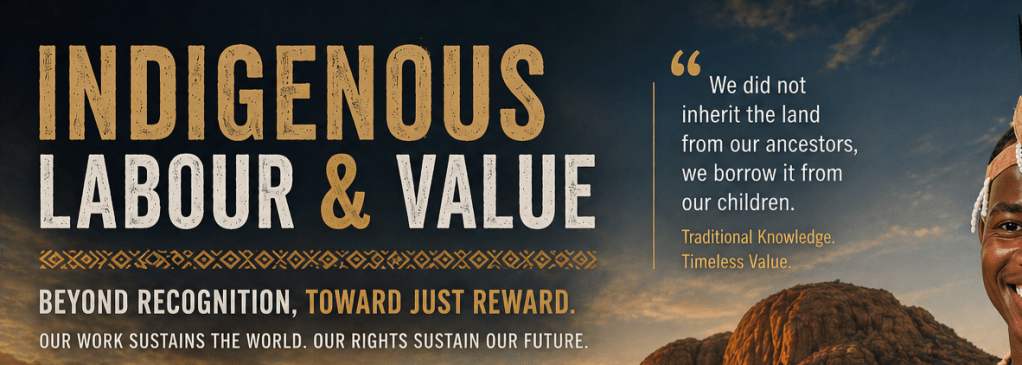
INDIGENOUS LABOUR: CONTRIBUTION BEYOND FORMAL SYSTEMS
Recent analysis from the International Labour Organization highlights that indigenous labour often exists outside formal employment classifications, yet plays a critical role in sustaining ecosystems, economies, and cultural continuity.
Indigenous peoples represent over 6% of the global population, but account for nearly 19% of those living in extreme poverty (ILO, 2021). They are also significantly more likely to be engaged in informal employment, with limited access to social protection systems (ILO, 2020).
Scholarly work by Fikret Berkes underscores that traditional ecological knowledge is a cumulative and adaptive system, contributing directly to environmental management and long-term sustainability (Berkes, 2012).
Observers note that this disparity reflects structural differences in recognition rather than an absence of economic contribution.
GLOBAL PATTERNS OF VALUE CREATION AND DISTRIBUTION
Across regions, indigenous communities contribute to sectors such as conservation, tourism, and natural resource management, often forming the foundation of ecosystem sustainability.
However, research indicates that the distribution of economic benefits within these systems can be uneven. Studies, including those by Joseph Mbaiwa, highlight that while local communities participate actively, financial returns may vary across stakeholders (Mbaiwa, 2011).
This trend reflects a broader global pattern, where value generation and value capture do not always align.
A CHANGING WORLD OF WORK
The global labour landscape continues to evolve in response to technological advancement, environmental change, and shifting economic structures.
While these transitions create new opportunities—such as eco-tourism, conservation economies, and cultural industries—they also present risks, including exclusion from formal labour markets and reduced access to protections.
The International Labour Organization notes that indigenous populations remain disproportionately represented in informal work arrangements, limiting their access to benefits associated with formal employment (ILO, 2020).
DEVELOPMENT, AGENCY, AND INCLUSION
Development economist Amartya Sen defines development as the expansion of freedoms, including the ability to participate meaningfully in economic and social systems (Sen, 1999).
Within this framework, the focus shifts from participation alone to agency—ensuring that communities are able to influence decisions and benefit from outcomes.
GLOBAL FRAMEWORKS AND EMERGING ALIGNMENT
International agreements such as the Nagoya Protocol, under the Convention on Biological Diversity, emphasize the importance of fair and equitable sharing of benefits derived from natural resources and traditional knowledge (CBD, 2011).
While these principles are widely supported, implementation remains an ongoing process across jurisdictions.
A CONSTRUCTIVE PATH FORWARD
Analysts suggest that improving alignment between labour contribution and reward may involve:
Strengthening representation in governance structures
Enhancing transparency in revenue-sharing mechanisms
Integrating indigenous knowledge into formal economic valuation systems
Expanding access to social protection frameworks
These measures are widely viewed as incremental improvements that build on existing systems.
A MOMENT FOR REFLECTION
As International Workers’ Day approaches, the emerging global reflection is consistent:
Labour exists in multiple forms.
Value is generated across diverse systems.
Recognition and reward continue to evolve.
CONCLUSION
While global labour systems have transformed over time, in many indigenous contexts, work remains closely linked to land, identity, and sustainability.
Observers note that the opportunity ahead lies not in replacing these systems, but in ensuring they are:
appropriately recognized
fairly compensated
and meaningfully integrated into modern economic frameworks
As discussions around labour continue to develop, this perspective contributes to a broader, evolving global dialogue.
NOTE: I’m open to connect, engage, and learn—share your insights, your experiences, and let’s grow the conversation together- Kebonemotse Amos|Forward Enquiries at: kebonemotse_a@yahoo.com


 Kebonemotse Amos
Leave a comment